
Iran proposes that Armenia become a gas transit country: what is preventing it?
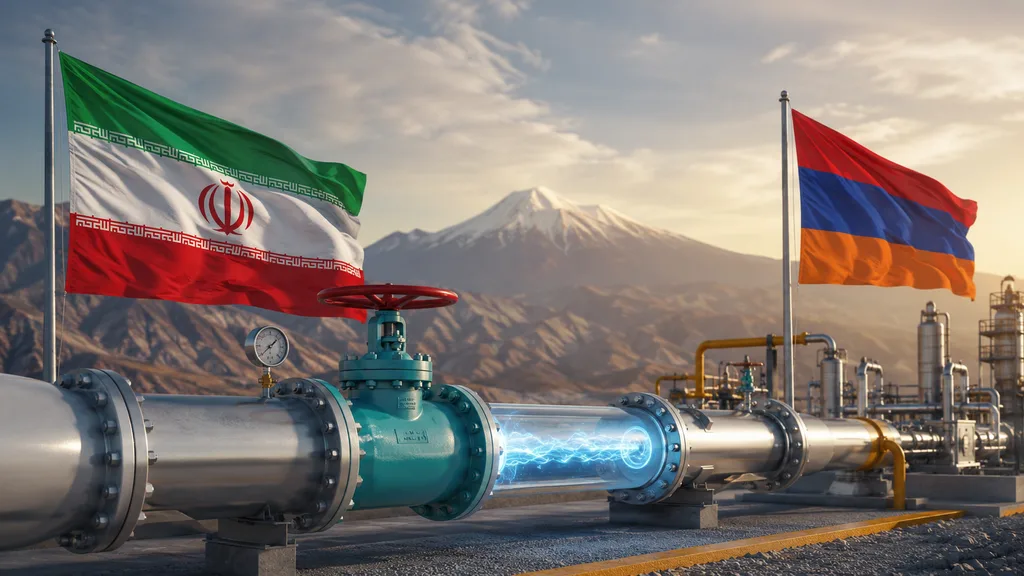
At the end of July, a proposal was made in Tehran that could change Armenia's energy role in the region. Iran proposes not only to increase the volume of gas exported to Armenia, but also to assess the possibility of transiting Iranian gas to other countries through the territory of Armenia.
Yerevan is in favor in principle. But when you look at the numbers and technical details, it turns out that the biggest obstacle was laid down twenty years ago—literally underground.
What happened and when
July 25, 2026, Tehran: David Khudatyan, Minister of Territorial Administration and Infrastructure of the Republic of Armenia, met with Iran's Oil Minister Mohsen Paknejad during a three-day working visit.
According to the Iranian Tasnim agency, Paknejad noted that Tehran had offered Yerevan a new commercial framework to expand natural gas exports. The Iranian minister added that the implementation of the proposal requires a comprehensive assessment of existing infrastructure, as well as considering the possibility of using Armenia's territory as a regional transit corridor.
The parties agreed to establish a joint specialized working group in the energy sector, focusing on gas trade.
Important clarification: on the day of the meeting, the Armenian side did not release details. All initial data came from Iranian sources. Only after the visit, Khudatyan announced that the volume of the "gas-for-electricity" project could at least be doubled, and that in the long term, this could create opportunities for gas transit in other directions.
What is the "gas-for-electricity" project
The proposal is about expanding this very mechanism, so it is worth understanding how it works.
This is a barter scheme, not a regular purchase and sale. Iran provides natural gas to Armenia. Armenia converts it into electricity and returns it to Iran at a rate of 3 kilowatt-hours of electricity per 1 cubic meter of gas.
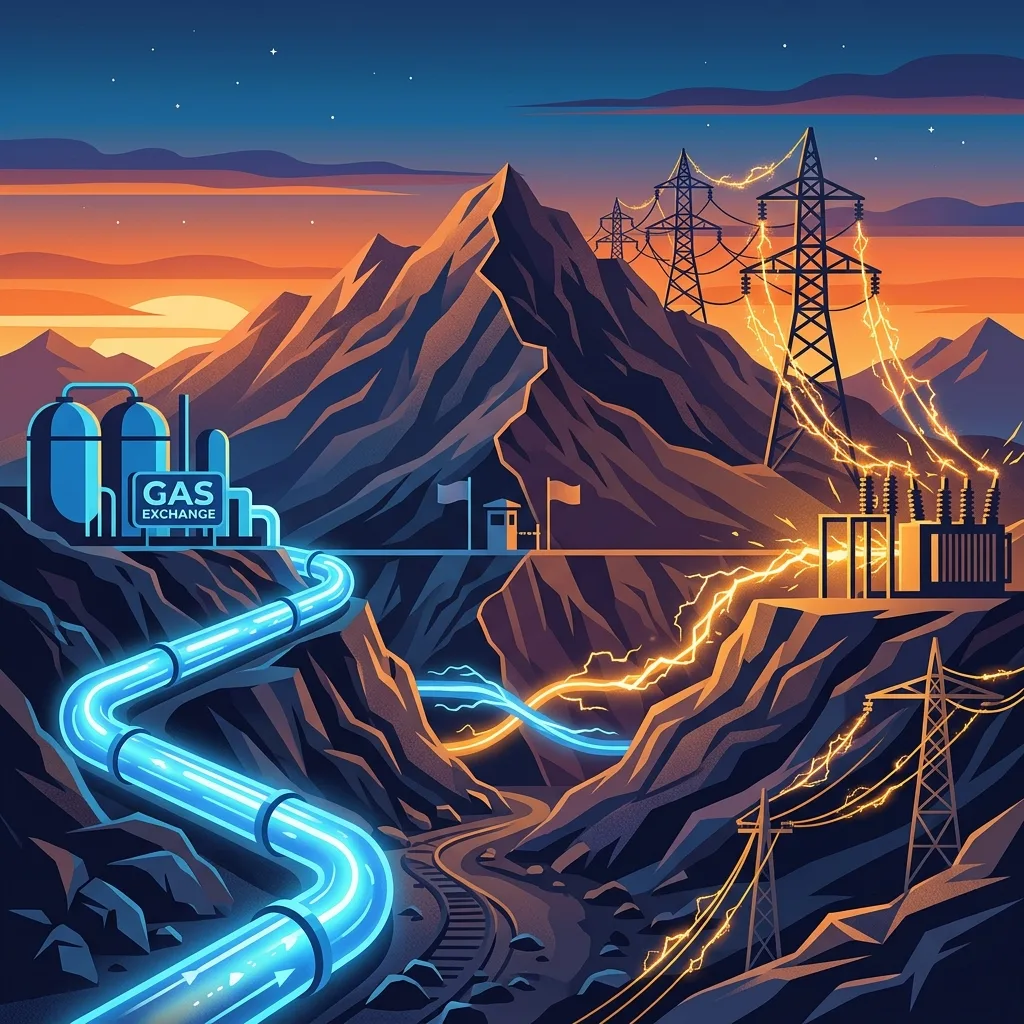
Armenia's benefit: the power plants generate 4–4.5 kWh from 1 cubic meter. The surplus remains in Armenia. And since gas is exchanged for electricity, the pricing issue does not arise at all.
The program has been operating since 2009. The barter agreement itself was signed in 2006.
The deadline: The agreement was in effect until 2026. On August 10, 2023, a document was signed in Yerevan to extend the term until 2030. It was signed by Aram Ghazaryan, Director of Yerevan Thermal Power Plant, and Majid Chegeni, Head of the National Iranian Gas Company.
The numbers: actual data for 2025
| Indicator | 2025 | 2024 | Change |
|---|---|---|---|
| Gas from Russia | 2.229 billion m³ | 2.288 billion m³ | −2.6% |
| Gas from Iran (barter) | 475.8 million m³ | 446.3 million m³ | +6.6% |
In total, Armenia imports about 2.7–2.8 billion cubic meters of gas annually. About 85 percent comes from Russia, and about 15 percent via the Iran-Armenia pipeline.
"Gazprom Armenia" is the sole supplier and has a monopoly on gas imports and domestic distribution in Armenia.
History of the pipeline: where the main problem comes from
This is the most important part of the article, and it is rarely covered.
Plans for the Iran-Armenia gas pipeline date back to the 1990s. The intergovernmental agreement was signed in 2004. The official opening of the first section took place in 2007, and the pipeline was launched in 2009.
Route: from Tabriz (north-western Iran) to the Ararat province of Armenia. Current annual capacity: about 2 billion cubic meters.
But the original plan was larger. Armenia and Iran viewed the project not only as a bilateral energy link, but also as a transit route to bring Iranian gas to European markets.
That prospect met with strong resistance from Russia, which dominated European gas supplies at the time.
Here is the key fact: according to a broad consensus of regional energy experts, under Russian pressure, the diameter of the Armenian section of the gas pipeline was reduced from the originally planned 1,200 mm to 700 mm. Subsequently, the pipeline was transferred to the ownership of Gazprom.
The reduced diameter limited the pipeline's long-term expansion potential and practically ruled out the possibility of using it as a major export corridor to Europe.
In other words, when people talk about Armenia as a gas transit country today, they are referring to a potential that was consciously reduced twenty years ago.
How much can the volumes be increased?
Theoretically, if the existing pipeline is used to its full technical capacity, imports from Iran could increase about fourfold.
In practice, this requires additional compressor stations along the pipeline to increase pressure. Substantially larger volumes would require the construction of a new pipeline, which is a much more expensive undertaking.
Four real obstacles
1. The third high-voltage line, which has not been built for 16 years
This is perhaps the most concrete obstacle.
To increase volumes in the barter scheme, Armenia must be able to transmit more electricity to Iran. This requires the third Iran-Armenia high-voltage power transmission line.
The project was first announced in 2010 and has been delayed for years.
Without additional power transmission capacity, Armenia cannot significantly increase the electricity sent to Iran, and therefore cannot receive more gas.
2. The Armenian section of the pipeline belongs to Gazprom
The owner of the Armenian section is "Gazprom Armenia", a subsidiary of the Russian "Gazprom", which at the same time holds a monopoly on gas imports and domestic distribution in Armenia.
According to UN national expert Ara Marjanyan, increasing the volume of Iranian gas exports is impossible without the consent of the Russian side. The expert believes that negotiation is possible.
3. Difference in price and calorific value
Armenia buys Russian gas at a border price of about $165 per 1,000 cubic meters. Taking calorific value into account, the actual average price is about $177.
Iranian gas is usually more expensive on international markets. For example, Iran supplied gas to Turkey under long-term contracts at a price of about $400 per 1,000 cubic meters.
There is also a second, less noticeable factor: energy content. The average calorific value of Russian gas imported into Armenia is about 8 percent higher than that of Iranian gas. This means that from the same physical volume, the buyer receives more useful energy.
At the same time, it should be noted that gas pricing largely depends on political relations and contractual terms. Iran could offer Armenia a different price if the two governments agree.
4. Iran itself has a gas shortage
This seems contradictory, since Iran ranks second in the world in natural gas reserves after Russia. But the reason is geographical.
Most of Iran's population lives in the colder northern regions of the country, while almost all gas production comes from the South Pars field in the south.
In winter, Iran regularly struggles to transport enough gas to the northern provinces due to infrastructure constraints. To address seasonal shortages, Tehran itself imports gas from Turkmenistan through swap arrangements.
These domestic constraints mean that Iran's capacity to significantly increase exports is not unlimited, especially during peak winter demand.
Why is the proposal being made right now
The proposal comes at a time when Armenia is trying to diversify its economic and energy partnerships amid growing tensions with Russia.
Renewed discussions with Tehran coincide with Russian trade restrictions on Armenian exports and hints from Russian officials that gas prices could eventually rise.
Russian presidential spokesperson Dmitry Peskov stated that Armenia's preferential gas price could become market-based if Yerevan decides to leave the EAEU.
What is not yet known
- When will the joint Armenian-Iranian working group be established and what will its composition be?
- Does Gazprom agree to increase the load on the gas pipeline?
- What deadlines and what funding are set for the construction of the third high-voltage line?
- Which countries are implied by the formulation "transit in other directions," if the 700 mm diameter limits the volumes?
- Who is supposed to finance the compressor stations?
Summary
Iran's proposal has two layers.
The first is realistic: doubling the volume of the active barter program from 476 million cubic meters to about 1 billion. The gas pipeline's capacity allows this. The problem is the third high-voltage line and Gazprom's consent.
The second is much further off: Armenia as a transit corridor for Iranian gas. Here, the obstacle is not only political but also physical—a 700 mm diameter, which replaced the planned 1,200 mm two decades ago. Transit of this scale means a new pipeline, not an upgrade of the existing one.
The real indicator in the coming months will not be the number of statements, but one specific thing: whether the third high-voltage line will get funding and a deadline.
Sources
- CivilNet (member of IFCN and EFCSN fact-checking networks), Georgi Mirzabekyan, 31.07.2026 — https://civilnet.am/en/news/1013353
- Interfax, 11.03.2026 — https://interfax.com/newsroom/top-stories/116554/
- Interfax, 2023 — https://interfax.com/newsroom/top-stories/93459/
- Radio Free Europe/Radio Liberty (RFE/RL), Ruzanna Stepanyan, 27.07.2026 — https://www.azatutyun.am/a/irann-arajarkel-e-metsatsnel-gazi-artahanman-tsavalnery/33816024.html
- Radio Free Europe/Radio Liberty (RFE/RL) — https://www.azatutyun.am/a/gazi-artonyal-giny-karogh-e-shoukayakan-darnal-ete-erevany-oroshi-lkel-eatm-y-peskov/33764291.html
- ARKA — https://arka.am/en/news/economy/armenia_and_iran_extend_natural_gas_for_electricity_agreement_until_2030/
- International Energy Agency (IEA), Armenia Energy Profile — https://www.iea.org/reports/armenia-energy-profile/overview


💬CommentsClick to read and leave a comment⌄
No comments yet. Be the first!