
Harich Monastery: From the Kamsarakans to the Zakaryans
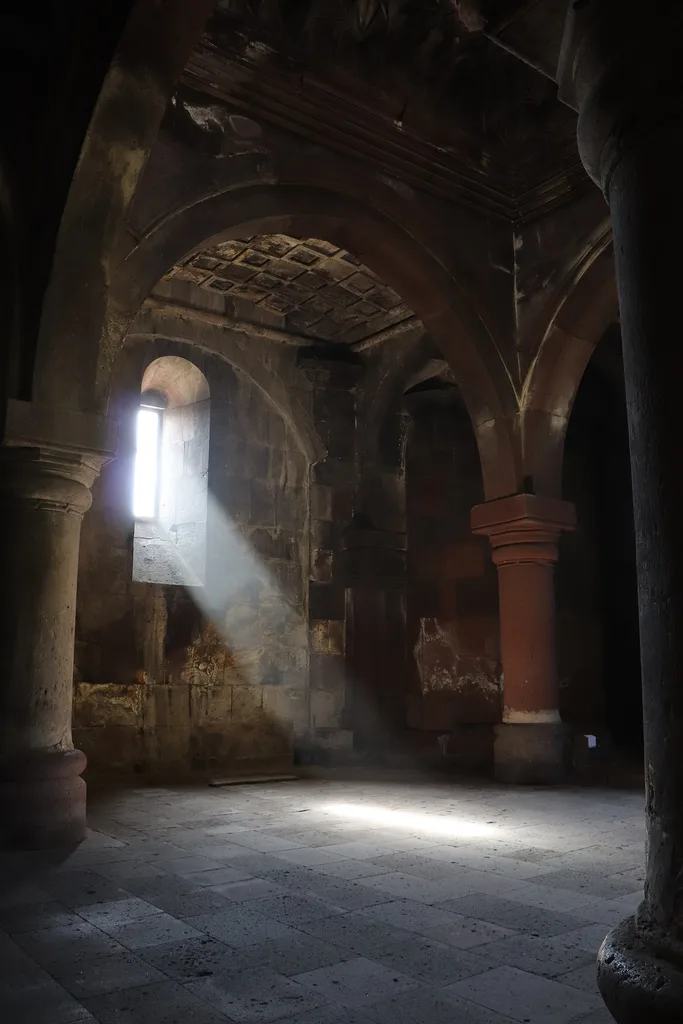
Harichavank Monastery in the Shirak Province
Harichavank Monastery is located in the village of Harich in the Shirak Province. It is one of the notable centers of Armenian medieval architecture and cultural life. The oldest structure of the complex is the 7th-century Church of St. Gregory. In later centuries the monastery was expanded with new buildings, and today it is a unique combination of the architectural thought of different eras.
The Early Middle Ages and the Kamsarakans
In the early Middle Ages, Shirak and the adjacent territories were within the domains of the Kamsarakan princely house. The construction of the Church of St. Gregory is usually linked with precisely that period. The 7th-century church attests that the monastery was already an important spiritual center at that time. It was built at a time when Armenian architecture was shaping its classical types of domed structures. Opinions differ regarding the exact date of construction and the person who commissioned it, so it is appropriate to speak mainly of the 7th century.
The Architecture of the Church of St. Gregory
The Church of St. Gregory is the main and oldest building of the monastery. It is built of local stone and, with its clear volumes and restrained decoration, is characteristic of 7th-century Armenian architecture. Over the centuries the building suffered from earthquakes and foreign invasions. As a result of repairs, some of its parts, especially the upper section, underwent changes, so the later layers are noticeable.
The Zakarian Period
At the end of the 12th century and the beginning of the 13th, the Zakarians, the brothers Zakare and Ivane, who liberated a considerable part of Armenia, paid attention to the construction of Armenian monasteries. Harich experienced a new upsurge in that period. At the beginning of the 13th century the Church of the Holy Mother of God (Surb Astvatsatsin) was built in the monastery, and in the 13th century the gavit. The gavit is adjoined to the Church of St. Gregory and served as a gathering place and assembly hall. With these additions the monastery became a complex of many buildings. The buildings of that period stand out for their fine stone working and ornamental carvings, which reflect the flourishing of 13th-century Armenian architecture.
Harich as a Cultural Center
Harich lived not only as a place of worship but also as a center of manuscript copying and learning, in keeping with the custom of Armenian medieval monasteries. The monastery's lapidary inscriptions are an important source for studying the construction history of the complex.
Restorations of Modern Times
The monastery, damaged over the centuries, underwent repairs in modern times. These helped preserve the main volumes of the complex, but at the same time introduced changes to the appearance of individual parts. For this reason, researchers strive to distinguish the original medieval stones from the layers of later restorations. This distinction is of great importance for the correct understanding and preservation of the complex.
Its Significance Today
Harichavank Monastery is an inseparable part of the spiritual and architectural heritage of Shirak. Standing side by side here are the church of the Kamsarakan period and the structures of the Zakarian era, which makes it possible to see in one place two important stages in the development of Armenian architecture. The study and preservation of the monastery is an important part of preserving our cultural memory.
Sources
- Toros Toramanian — Materials for the History of Armenian Architecture
- History of the Armenian People (Institute of History of the Academy of Sciences of Armenia)
💬CommentsClick to read and leave a comment⌄
No comments yet. Be the first!