
Mount Nemrut. The lost tomb of the Orontid king above the clouds
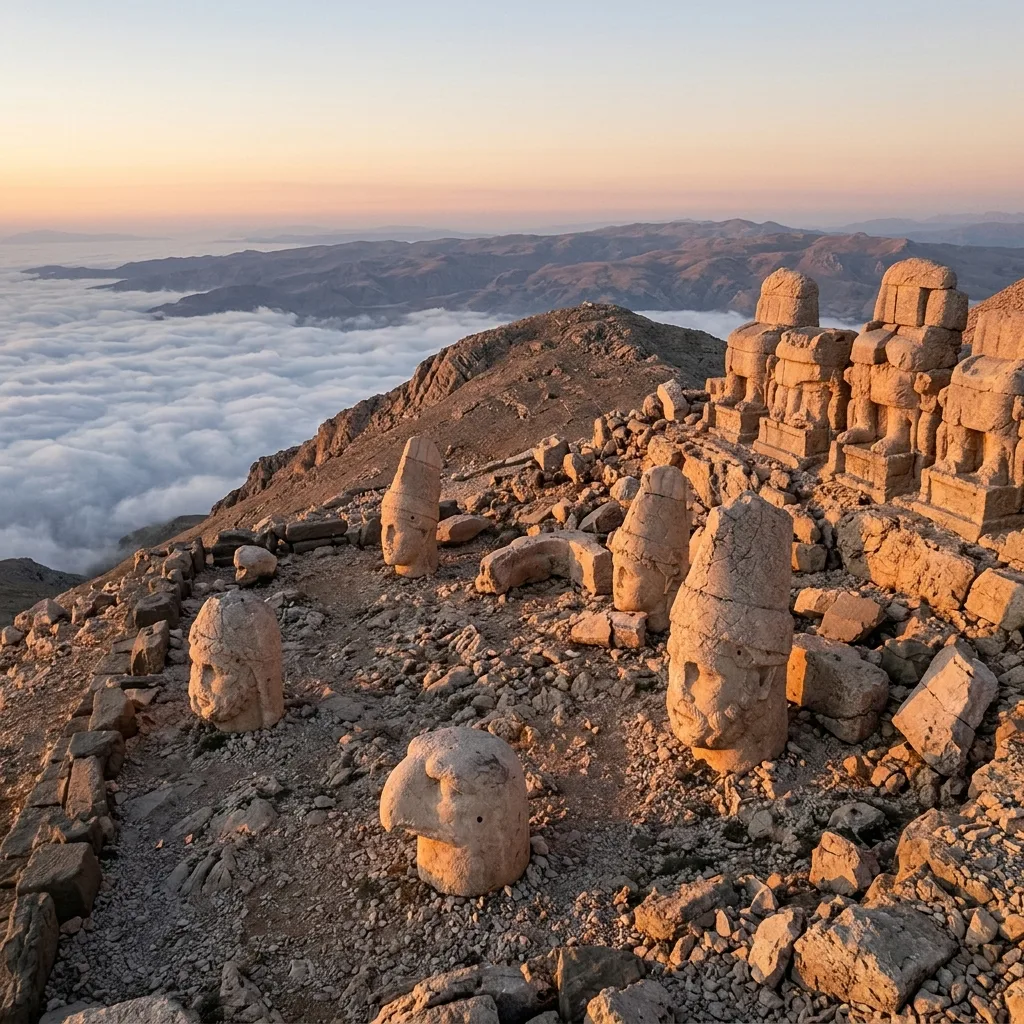
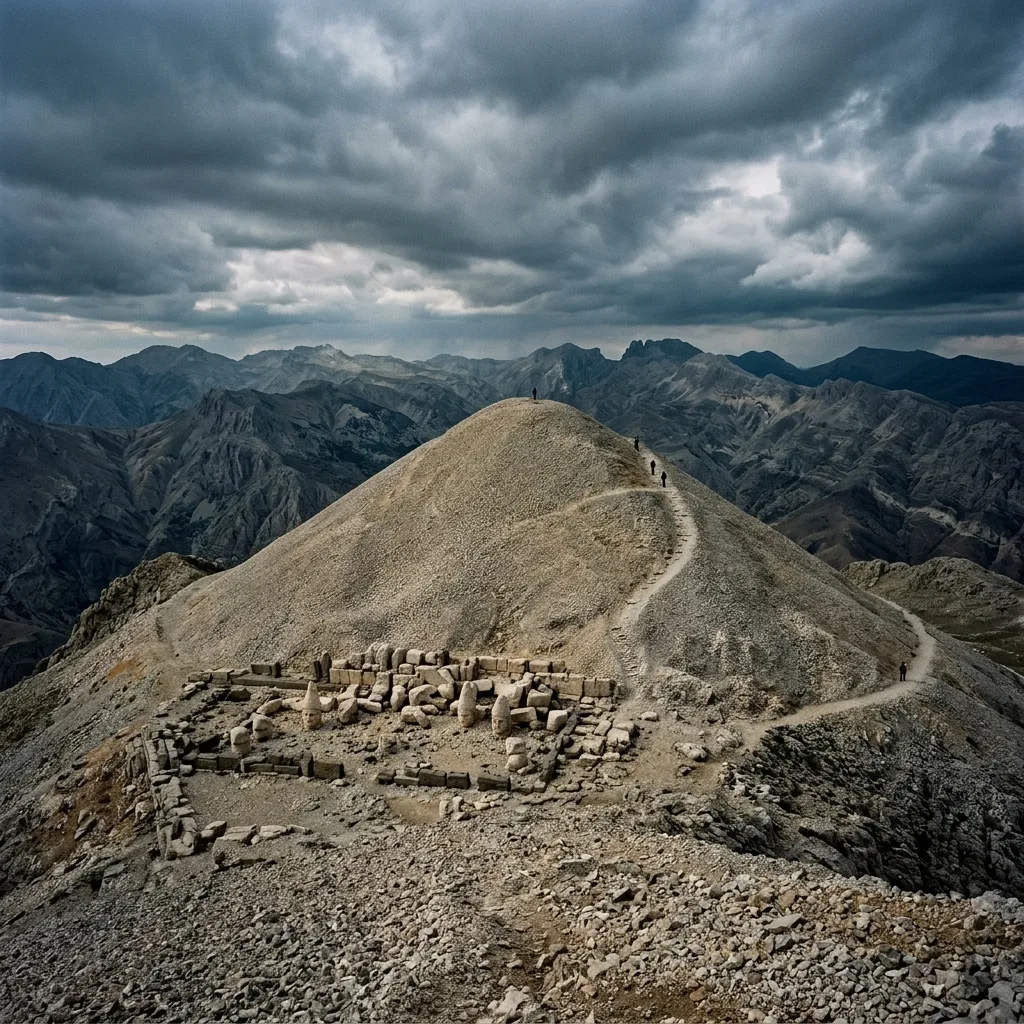
In the Adıyaman province of southeastern Turkey, at an altitude of 2134 meters above sea level, there is a bare and rocky peak. There is no water, no trees, no reason for a person to climb it. And it was right there, two thousand years ago, that a king decided to build his eternal home.
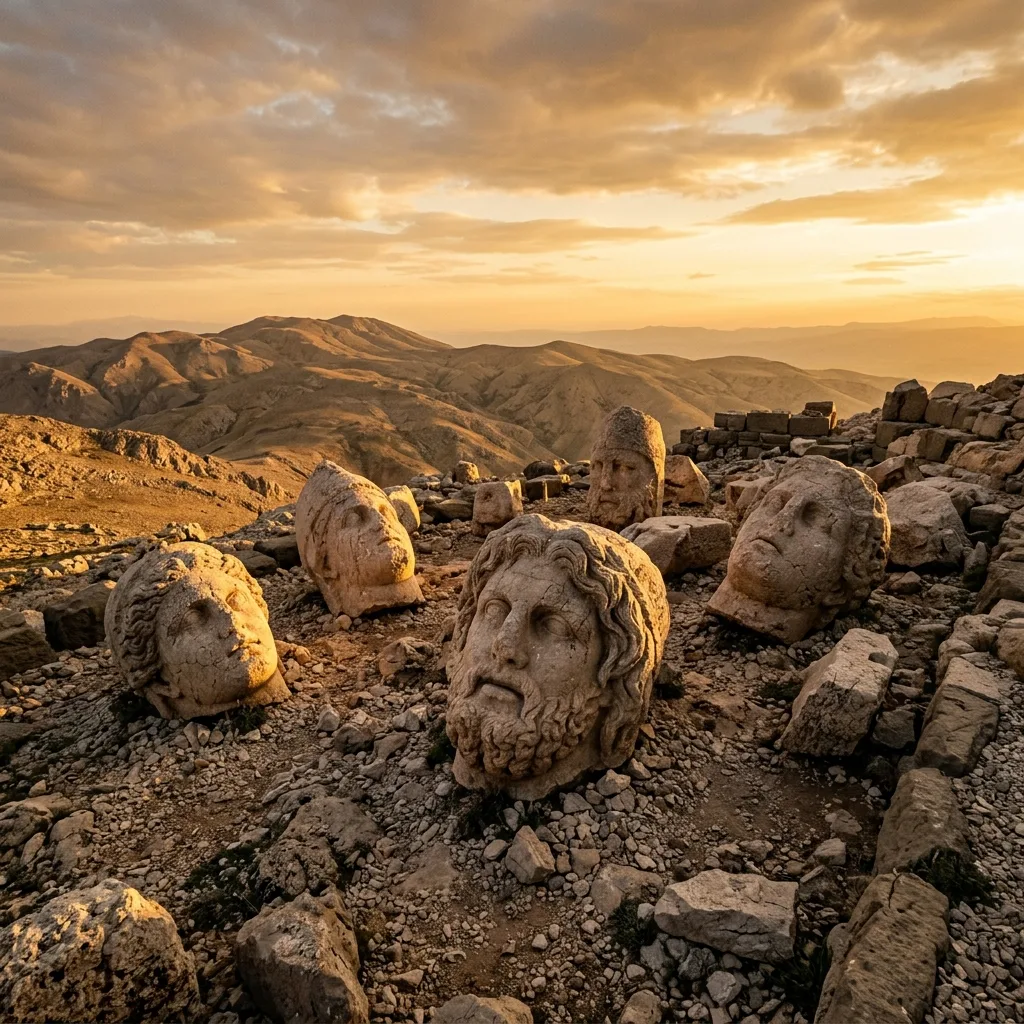
Today, stone heads weighing tens of tons lie on that peak, facing the sky. And their master, the king, has not been found to this day.
Commagene: A Kingdom Between Two Empires
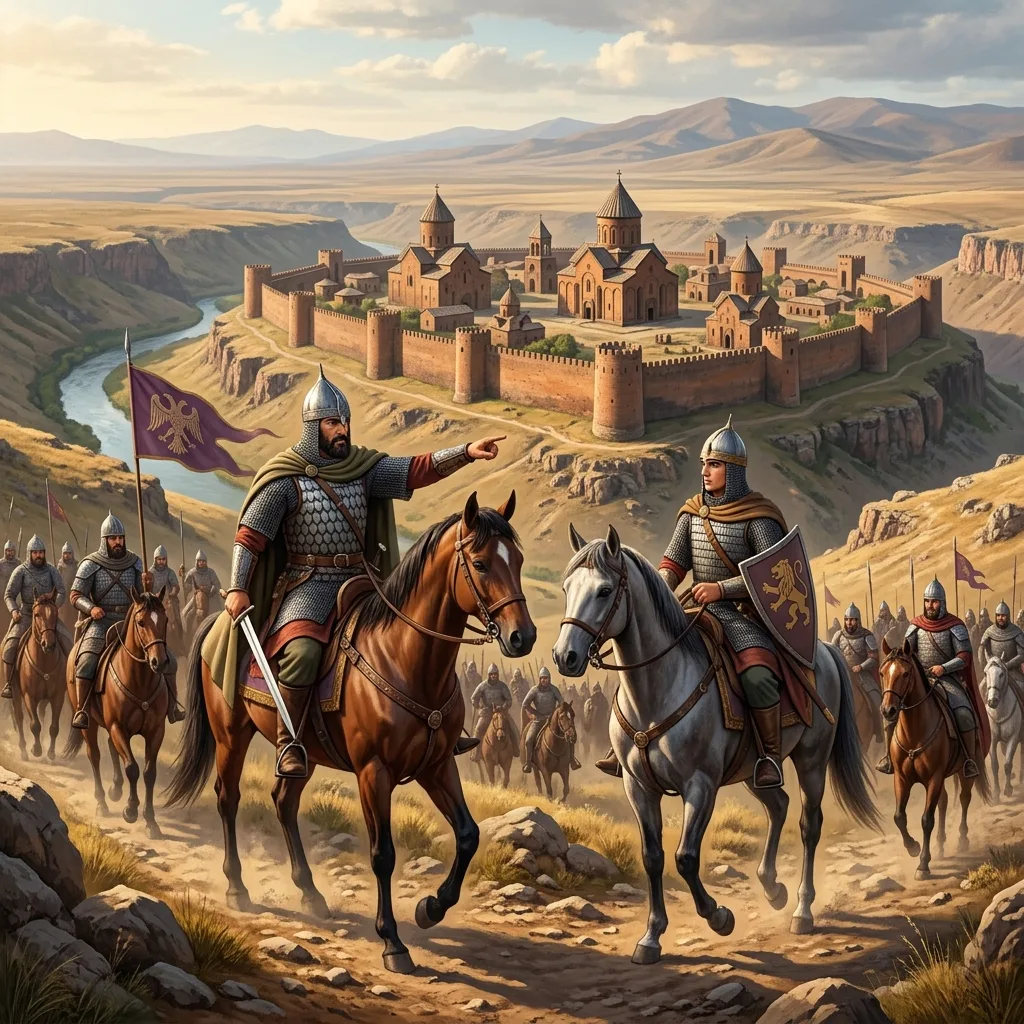
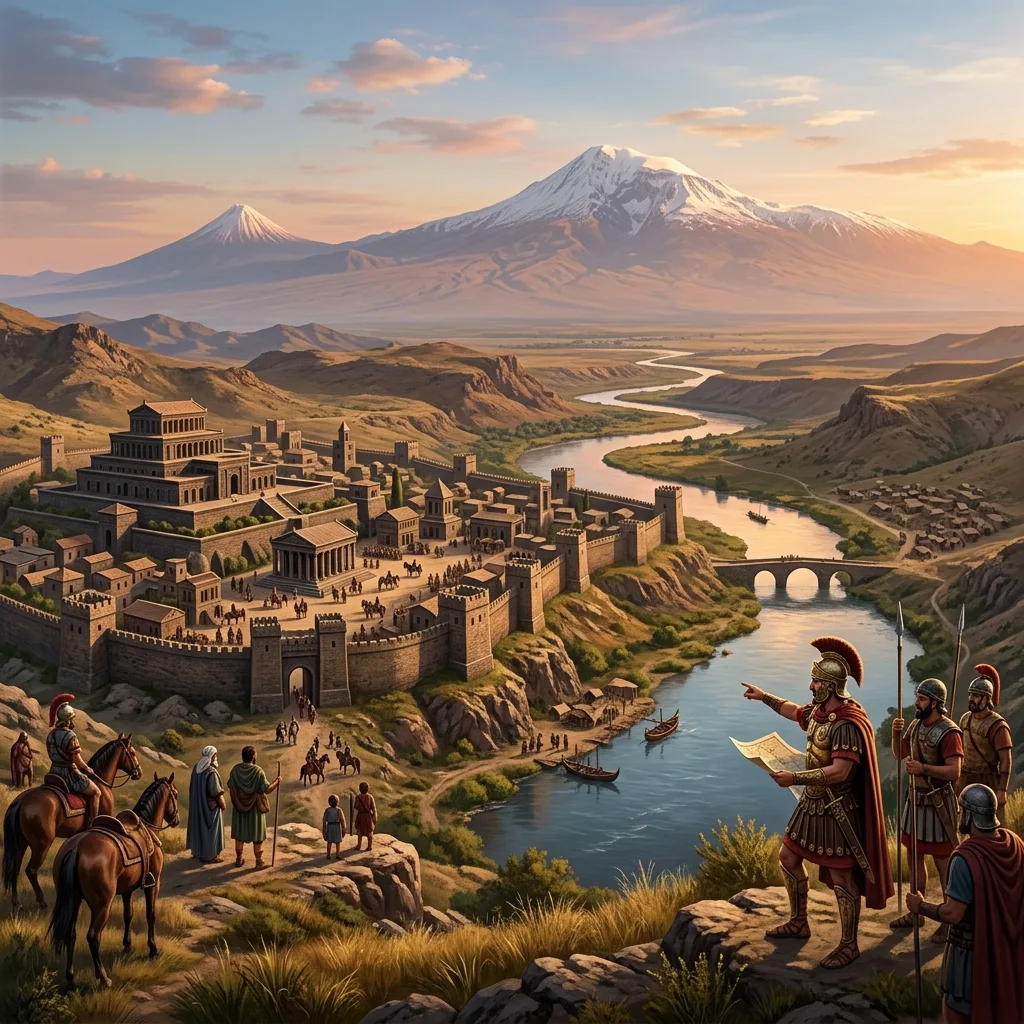
In the 2nd century BC, the Seleucid Empire was collapsing. Amidst this decay, a small but incredibly wealthy kingdom emerged on the western bank of the Euphrates: Commagene, with its capital at Samosata (now Samsat).
Commagene was a buffer state between Rome and Parthia, situated on trade routes and key crossings of the Euphrates. This position brought it both wealth and constant danger. Throughout its history, this kingdom survived through diplomacy, balancing between the two giants, until Emperor Vespasian put an end to its independence in 72 AD.
The ruling dynasty of Commagene descended from the Orontids (Yervandunis), the same dynasty that had ruled Armenia for centuries. A branch of the Orontids established themselves in Commagene after the collapse of the Achaemenid Empire.
Antiochus I Theos: The King Who Declared Himself a God
Around 70 BC, Antiochus I Theos ascended the throne, the son of Mithridates I Callinicus and the Seleucid princess Laodice.
This marriage was not accidental, and it is the key to Antiochus's entire ideology. On his father's side, he connected himself to the Persian world, tracing his lineage back to Darius I the Great. On his mother's side, he connected to the Greek world, back to Alexander the Great and Seleucus I.
In other words, Antiochus presented himself as the heir to both civilizations. And Nemrut is the stone embodiment of that very idea.
Important clarification: Antiochus's own inscriptions emphasize his Persian and Macedonian origins, not the Armenian one. The Armenian connection comes through the Orontid dynasty, which is a fact, but Commagene was not part of Armenia, it was a separate kingdom. It is important to understand this distinction.
Hierotheseion: What Was Built on the Summit?
Around 62 BC, Antiochus began his main project: the hierotheseion. This Greek word means 'sacred place'—simultaneously a tomb and a temple.
First, the peak was artificially raised: a huge tumulus (burial mound) composed of crushed limestone was built, about 50 meters high and around 145 meters in diameter. Note that this is entirely a pile of fist-sized stones, not a monolithic structure. This detail would later play a decisive role.
Three terraces were created around the tumulus: eastern, western, and northern. On the eastern and western terraces, statues of seated giants were erected, 8-9 meters high, each weighing tens of tons. Guarding them on both sides were an eagle and a lion, symbols of power over heaven and earth.
Gods with Two Names
Here is the most interesting detail of Nemrut. In the inscriptions, the gods have double, sometimes quadruple names.
| Inscription Name | Armenian/Iranian Equivalent |
|---|---|
| Zeus-Oromasdes | Aramazd (Ahura Mazda) |
| Apollo-Mithras-Helios-Hermes | Mihr (Mithra) |
| Artagnes-Heracles-Ares | Vahagn (Verethragna) |
| Commagene | Goddess-protector of the land |
Seated on the fourth throne is Antiochus himself, alongside the gods and as their equal.
This was not a simple cult, but a conscious political program: to unite the two worlds of his subjects on a single stone. In the Greek inscriptions, you read Zeus, but the meaning is Aramazd. The name of Vahagn is written in Greek as Artagnes, a direct transliteration of the Iranian Verethragna.
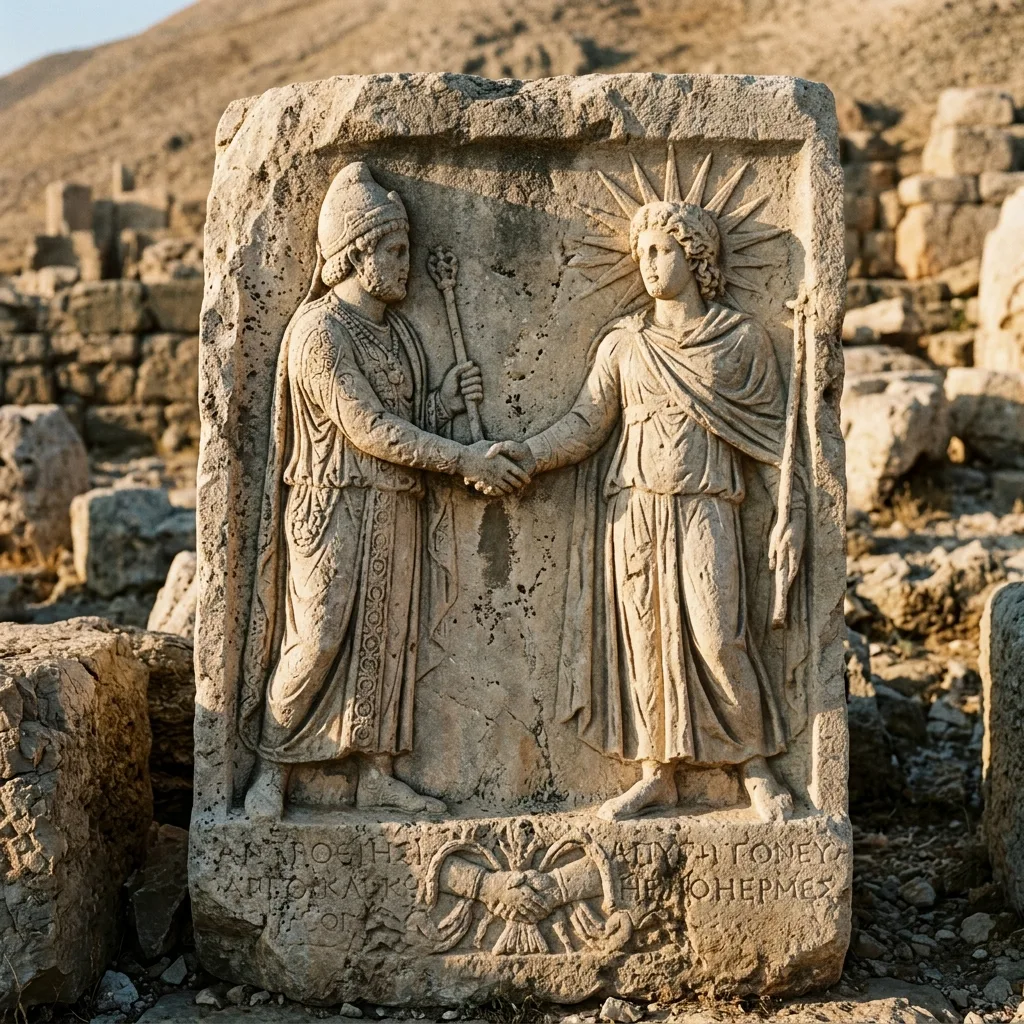
On the terraces, there are also the so-called dexiosis reliefs: Antiochus shaking hands with the gods. As equals.
The "Nomos": The King's Will in Stone
Carved on the backs of the thrones is Antiochus's Nomos, the cultic law. This is one of the longest Greek inscriptions of the ancient world, spanning over 200 lines.
In it, the king defines in detail how his cult must be preserved forever: on the 16th of every month, his birthday, and on the 10th, the day of his accession, celebrations were to be organized. Permanent priests were appointed, and lands and revenues were allocated. In the inscription, the king addresses future generations and pronounces a curse upon those who violate the order.
By a twist of fate, a few generations after Antiochus's death, Commagene no longer existed, and the summit was abandoned.
The Lion Horoscope: The World's Oldest "Dated Photograph"
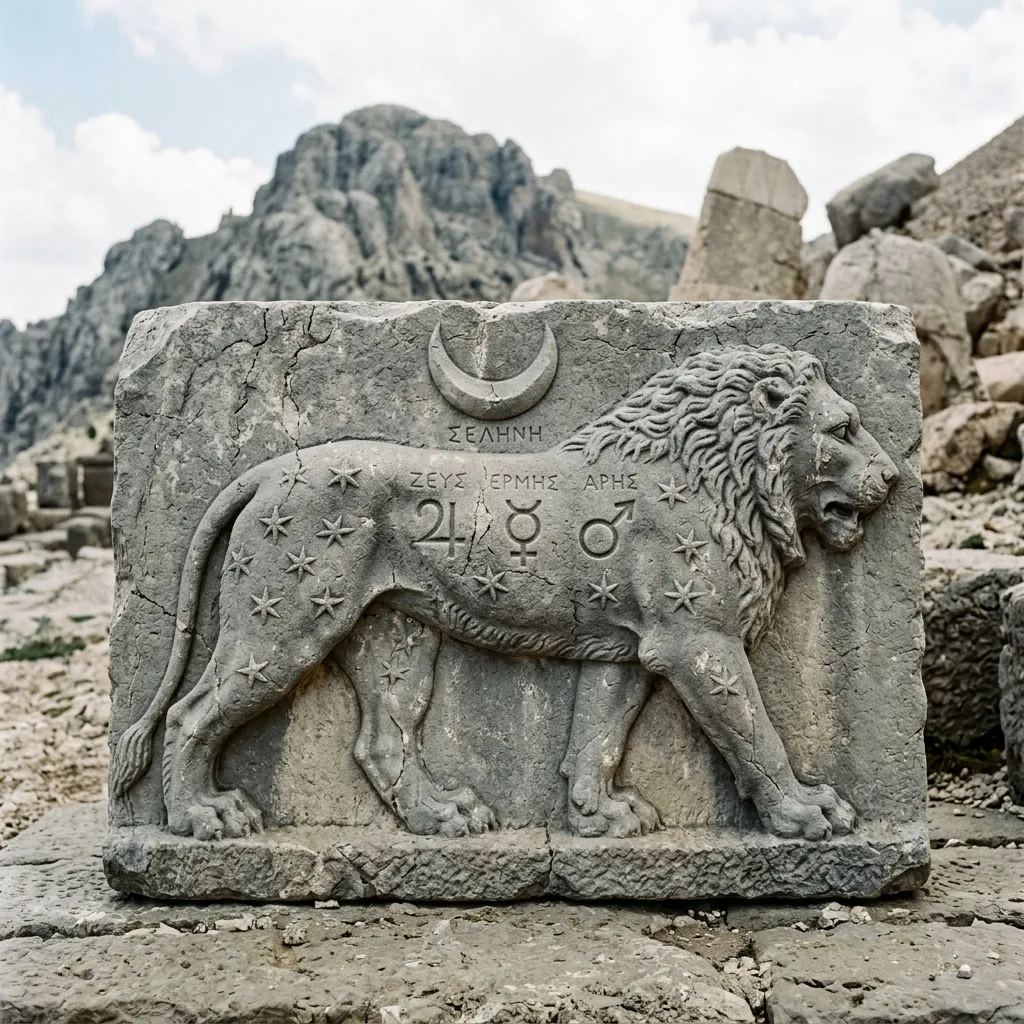
On the western terrace, there is a relief that is a true treasure of archaeology: the Lion Horoscope.
Nineteen stars and a crescent moon are carved on the lion's body, and on its back are three planets: Jupiter, Mercury, and Mars. This is a depiction of a real celestial alignment.
Astronomers have calculated the date of this alignment: according to the most common hypothesis, July of 62 BC. In all probability, it marks the day of the founding of the hierotheseion or Antiochus's official coronation. In other words, we have an ancient monument that dates itself to the exact day.
How Were the Stones Raised to the Top of the Mountain?
This question is often presented as an "unsolvable mystery." In reality, the answer exists, and it is more interesting than the mystery itself.
The stones were not brought up from elsewhere. The limestone was quarried right on the mountain, a few hundred meters below the summit. Archaeologists have found traces of these quarries, as well as unfinished blocks.
Standard but highly effective methods of the time were used:
- inclined planes (ramps) along which the blocks were dragged on sledges
- levers and wedges for precise positioning
- multi-layered horizontal sections: the statues are not monolithic, but assembled from 6-8 separate blocks placed on top of each other. Each block was individually transportable.
This last solution is the key. No one raised a 50-ton statue; instead, separate 6-8 ton sections were hauled up and then assembled on top of each other. The same principle was used in Egypt and Mesopotamia.
Why Did the Heads Fall?
Today, the heads of all the statues are on the ground, severed from the bodies, often several meters away.
The main explanation is earthquakes. The region is seismically active, and the structure of the statues—blocks stacked on top of each other without mortar—was practically defenseless against horizontal shocks. The head, being the topmost and heaviest element, was the first to fall.
There is also a secondary hypothesis: iconoclasm during the late antiquity and early Christian periods. However, the nature of the statues' fall—almost all in the same direction—points more toward an earthquake.
And Most Importantly: Where is Antiochus?
Here is the true mystery of Nemrut.
Antiochus's tomb has not been found to this day.
The monument was discovered for European science by the German engineer Karl Sester in 1881. In the following years, Otto Puchstein and Carl Humann worked there.
The most serious searches began in 1953 under the leadership of the American archaeologist Theresa Goell, who dedicated more than twenty years of her life to Nemrut. She tried everything:
- digging tunnels from the base of the tumulus
- drilling from the summit
- using geophysical equipment of the time
The result: zero.
The problem lies in the structure of the tumulus itself. It consists entirely of loose, crushed stone. Every time you dig a tunnel, the stones slide like sand and fill the hole. This makes conventional excavation physically impossible without dismantling the entire hill, which would destroy the monument.
Modern geophysical surveys—radar and seismic—have also failed to give a definitive answer. Some data hint at a possible cavity, but nothing is confirmed.
There are three main hypotheses:
- The chamber exists under the tumulus, carved into the bedrock, and we simply haven't reached it yet.
- The chamber exists but is empty—Antiochus is not buried there because he didn't manage to finish it or died elsewhere.
- There is no chamber at all—the hierotheseion was a symbolic monument, not a real tomb.
Interesting fact: The hierotheseion of Mithridates, Antiochus's father, at Arsameia on the Nymphaios (now Eski Kâhta) has a huge, inclined tunnel carved into the rock, over 150 meters deep. It also did not reveal any burial chamber. It seems this dynasty deliberately hid their dead.
Visiting Nemrut
The monument has been on the UNESCO World Heritage List since 1987.
Practical Information:
- Nearest town: Kâhta (Adıyaman province)
- Season: April–October. In winter, the road is closed due to snow
- Best time: sunrise on the eastern terrace or sunset on the western. The statues were designed for this exact light
- It is about a 600-meter steep uphill walk from the parking lot to the summit
Nearby, it is also worth seeing the Karakuş Tumulus, the burial mound of the Commagene royal women, and the Severan (Cendere) Bridge, which still stands after 1,800 years.
Frequently Asked Questions
Is Mount Nemrut in Armenia? No. It is located in the Adıyaman province of Turkey. Note: there is another volcano of the same name, Mount Nemrut, near Lake Van. These are different places.
Was Antiochus I Armenian? He was a representative of the Orontid (Yervanduni) dynasty, the same dynasty that ruled Armenia. However, he presented himself as a Persian-Macedonian heir, and Commagene was a separate kingdom.
How old are the statues? About 2,085 years old—they were built around 62 BC.
Could the tomb be found in the future? Possibly. The development of non-invasive technologies—such as muon tomography or high-resolution tomography—could provide an answer without damaging the tumulus.
💬CommentsClick to read and leave a comment⌄
No comments yet. Be the first!